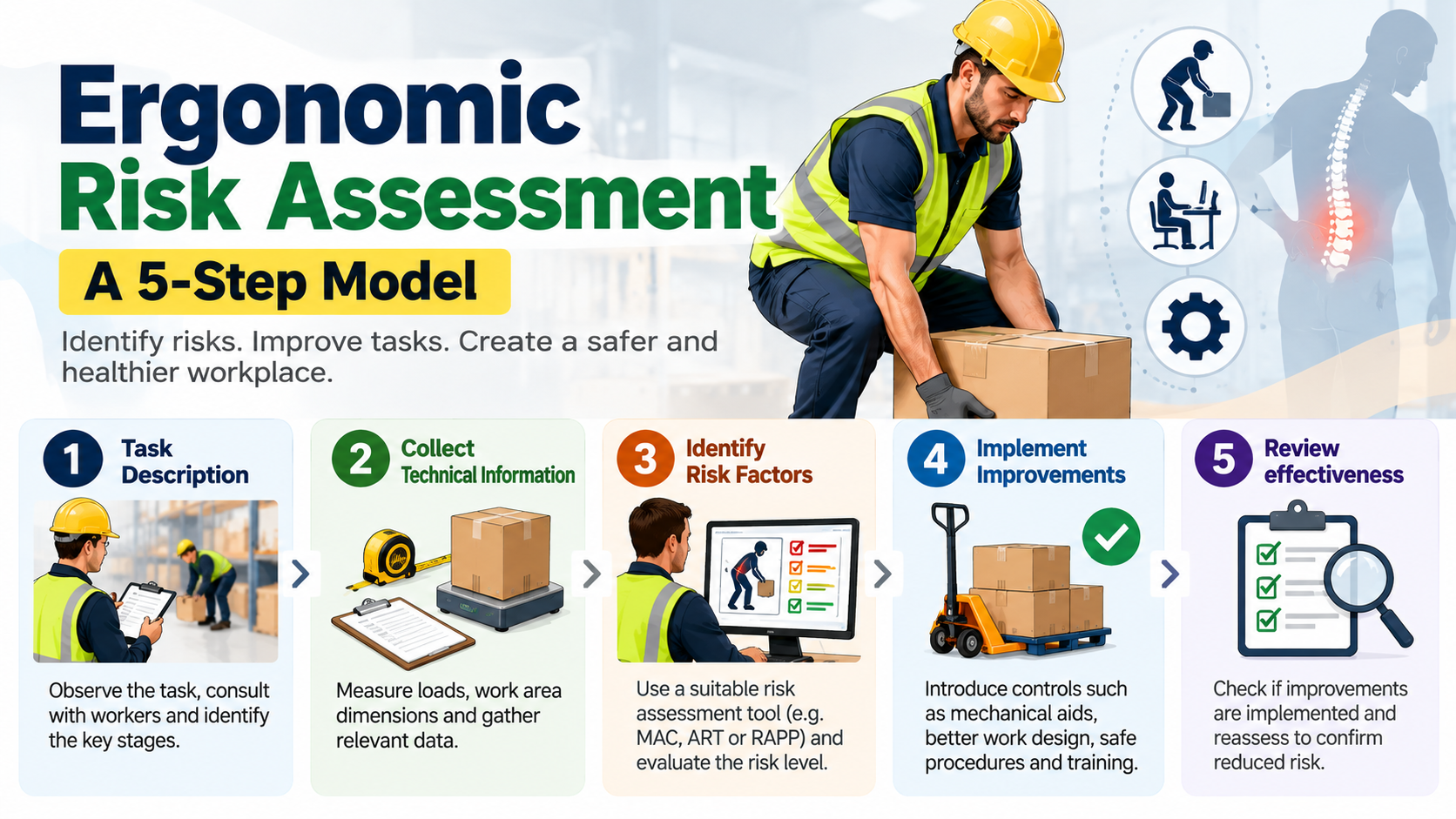
Ergonomic Risk Assessment
Ergonomic Risk Assessment
Ergonomic risk assessment is a systematic process used to identify factors that may contribute to musculoskeletal injuries, excessive physical strain, and repetitive-task injuries.
It is particularly useful for workplaces involving manual handling, repetitive upper-limb movements, awkward postures, lifting, pushing, pulling, and prolonged physical tasks.
A practical ergonomic assessment can be organized into five key steps:
1. Describe the task → 2. Collect technical information → 3. Identify risk factors → 4. Implement improvements → 5. Review the results
Step 1: Describe the Task
Start by observing how the task is actually performed.
Speak with the workers involved and identify the main stages of the activity. Where appropriate and with consent, photographs or video recordings can help document important postures and movements.
For manual lifting tasks, consider:
Load weight
Frequency of lifting
Lifting height
Distance of the load from the body
Bending or twisting
Grip on the load
Floor and environmental conditions
Goal: Understand what the worker actually does during the task.
Step 2: Collect Technical Information
Next, collect measurable information about the task and workplace.
This may include:
Load weight
Work surface height
Lifting and reaching distances
Storage height
Frequency and duration of the task
Observed working postures
Tools such as a measuring tape, weighing scale, photographs, and video recordings can provide useful information.
Accurate measurements help make the risk assessment more objective.
Step 3: Identify the Risk Factors
Use an appropriate ergonomic risk assessment tool to evaluate the information collected.
Depending on the task, tools such as:
MAC Tool – Manual Handling Assessment Charts
ART Tool – Assessment of Repetitive Tasks
RAPP Tool – Risk Assessment of Pushing and Pulling
may be appropriate.
The assessment should document why a particular risk level has been assigned.
For example, a combination of heavy loads, frequent lifting, awkward posture, and excessive reaching may indicate a higher ergonomic risk.
Step 4: Implement Improvements
Once the risks are identified, practical controls should be introduced to eliminate or reduce them.
Possible improvements include:
Mechanical Assistance
Use hoists, trolleys, conveyors, lifting equipment, or other mechanical aids.
Workplace Reorganization
Reposition materials, tools, and equipment to reduce unnecessary reaching, bending, or twisting.
Safe Work Procedures
Develop clear procedures, method statements, or standard operating procedures for higher-risk tasks.
Worker Training
Train employees on the correct use of equipment and safe work practices.
The best solution is usually one that reduces the physical demand of the task rather than relying only on worker technique.
Step 5: Review the Improvements
An ergonomic assessment should not end after improvements are introduced.
Review the task to confirm that:
Recommended controls have been implemented
Workers are using them correctly
The original risk factors have been reduced
The new process is practical and effective
Where appropriate, the risk assessment tool can be used again to compare the new risk level with the original assessment.
Assess → Improve → Reassess
Common Ergonomic Risk Factors
During an assessment, pay particular attention to:
Heavy or awkward loads
Repetitive movements
Bending and twisting
Excessive reaching
High or low working heights
Poor grip
Long carrying distances
Forceful movements
Prolonged static postures
Poorly designed workstations
Identifying these factors early can help prevent work-related musculoskeletal problems.
Why Is Ergonomic Risk Assessment Important?
A structured assessment can help organizations:
Identify workplace ergonomic hazards
Reduce unnecessary physical strain
Improve work processes
Select appropriate control measures
Reduce the likelihood of musculoskeletal injuries
Improve workplace safety and efficiency
Conclusion
Ergonomic risk assessment is an ongoing process rather than a one-time activity.
By observing the task, collecting accurate information, identifying risks, implementing controls, and reviewing the results, workplaces can create safer and more efficient working conditions.
The key principle is simple:
Identify the risk → Control the risk → Review the result.
Frequently Asked Questions
Common therapeutic queries answered by Curevan's medical board.
Share this Article
Help your friends, family, or colleagues discover this guide.